
Your Essential Guide to Live Precious Metal Prices
Synopsis
This blog explores the importance of live precious metal prices - also known as spot prices - and how they impact buying and selling decisions for gold, silver, platinum, and palladium. It explains how live charts work, what influences market movements, and how investors can use real-time data to track performance, identify trends, and make more informed investment choices.

Your Essential Guide to Live Precious Metal Prices
In the dynamic world of precious metals, staying informed with real-time pricing is crucial, especially when it comes to gold and silver. Whether you're a seasoned investor, new to investing or you are planning a significant investment – knowing where to find accurate, live precious metal prices is going to help you make an informed decision. But it’s important to understand how it is derived too. Why? Because it can impact when you choose to buy as well as what you choose to buy.
Given that the price of gold and silver is extremely volatile, with spot prices changing by the minute, it’s a good idea to familiarise yourself with pricing and how it works.
What are "Live Precious Metal Prices" (Spot Prices)?
Live precious metal prices refer to the ‘spot price’.
The spot price is the current market price at which a precious metal can be bought or sold for immediate delivery. It's a real-time reflection of global supply and demand, influenced by many elements, including economic data and geopolitical events through to currency fluctuations and supplies. Spot prices are typically quoted per troy ounce and are what dealers base their premiums on.
You can find more on this in our ‘Spot Prices’ Blog.
The Live Gold Price for example, shows you all kinds of information:
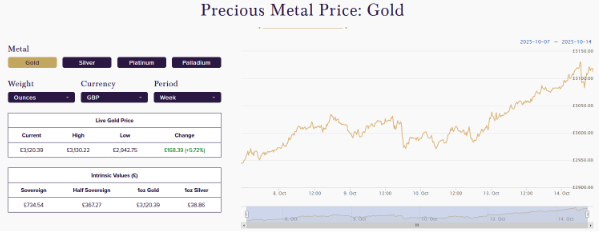
Here you can see options to break down pricing by weight, currency and period, as well as the ‘high’ and ‘low’ prices of your chosen precious metal.
By clicking on the Silver option, you will get the same information for that precious metal.
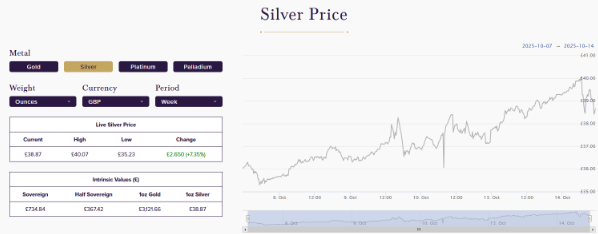
Again, you can see it includes key information as well as the ‘change’ determining how much it has risen or dropped during a period of time.
What’s useful about a Live Precious Metals chart?
Live precious metals charts are incredibly useful tools for anyone looking to navigate the investment world of gold, silver, platinum, and palladium.
1. Understanding Real-Time Market Sentiment and Volatility
Precious metals are often seen as safe-haven assets, meaning their prices can react dramatically to global economic and geopolitical events. A live chart allows you to witness these reactions as they happen.
- Spotting Trends: Are prices steadily climbing, indicating growing investor confidence or a response to inflationary pressures? Or are they in a downtrend, suggesting a shift in market appetite? A live chart provides an immediate visual of these ongoing trends, allowing you to assess the current market sentiment towards precious metals.
- Gauging Volatility: Precious metals markets can be volatile. A live chart helps you visualise the magnitude and frequency of price swings. This information is crucial for understanding the risk associated with your investments and for making informed decisions about when to enter or exit the market. Sudden spikes or drops on the chart can signal significant news events or shifts in investor behaviour.
2. Identifying Optimal Entry and Exit Points
For active traders and even long-term investors, timing can be everything. Live charts are invaluable for pinpointing opportune moments to buy or sell.
- Technical Analysis: This is where charts truly shine for many. Technical analysts use chart patterns, indicators (like moving averages), and price action to predict future price movements. A live chart provides the most up-to-date data for applying these techniques. You can identify support and resistance levels, chart formations, and determine if a particular price point represents a good buying opportunity or a signal to sell before a potential downturn. This kind of analysis is better suited to experienced investors and it’s important to note that the charts cannot predict the actual future. They are a guide only.
- Reacting to News: When major economic data is released or significant geopolitical events unfold like the war in the Ukraine for example, precious metals prices can react swiftly. A live chart allows you to see these immediate price adjustments and potentially capitalise on them before the broader market fully digests the news.
3. Tracking the Performance of Your Holdings
If you already own precious metals, a live chart is your direct window into their current market value.
- Performance Monitoring: Beyond simply knowing the price, you can see how your specific holdings are performing relative to the live market price. This is essential for tracking your portfolio's growth or assessing potential losses.
- Rebalancing Decisions: Understanding the live price of your precious metals can inform decisions about rebalancing your portfolio. If gold has surged significantly, you might consider trimming your position to lock in profits, or if silver has dipped, it might present a good opportunity to add to your holdings.
4. Comparing Different Precious Metals
The precious metals market isn't monolithic. Gold may be performing differently than silver, or platinum might be experiencing unique price movements. Although it is common for silver to follow gold’s rallies to some degree – but not always.
- Relative Performance: By viewing multiple live charts side-by-side, you can compare the performance of different precious metals. This allows you to identify which metal is exhibiting the strongest or weakest trends, potentially guiding your investment strategy towards the most promising assets.
5. Informed Decision-Making in a Dynamic Environment
Ultimately, the usefulness of a live precious metals chart boils down to one key factor: informed decision-making. In a market influenced by a complex interplay of global factors, having access to real-time data empowers you to:
- Reduce emotional trading: Seeing prices fluctuate can be emotional. A chart, while displaying these fluctuations, provides objective data that can help you make more rational decisions based on analysis rather than gut feeling.
- Stay ahead of the curve: The market moves fast. Live charts ensure you're not operating on outdated information, giving you a competitive edge.
Where to Find Live Precious Metal Prices
Chards offers a comprehensive ‘live metals pricing’ page, where you can check the latest price on gold, silver, platinum and palladium in GBP, USD and other major currencies. You can also look at pricing over a week, a month, a year and even a lifetime. You may want to bookmark the page for future reference.
For more information on investing in precious metals, our blog has hundreds of useful investment articles on investing in gold, silver and specialist coins and its updated weekly.
Related Articles


This guide and its content is copyright of Chard (1964) Ltd - © Chard (1964) Ltd 2026. All rights reserved. Any redistribution or reproduction of part or all of the contents in any form is prohibited.
We are not financial advisers and we would always recommend that you consult with one prior to making any investment decision.
You can read more about copyright or our advice disclaimer on these links.