
22 Carat Gold or 24 Carat Gold Coins?
Synopsis
So, you're unsure about the difference between 22-carat gold and 24-carat gold? There's a common misconception that 24-carat gold is superior to 22-carat gold and therefore must be more valuable. However, this isn't necessarily true — both are typically produced to contain the same amount of pure gold. By the end of this guide, you'll understand the key differences and the benefits of adding either to your portfolio.

What Is a Carat?
A carat (or karat in the U.S.) is a unit used to measure the purity of gold in an alloy. The ratio of pure gold is calculated by using 24 parts as a whole, with one carat being equal to 1/24th of the whole and 22 carats being equal to 22/24 parts of the whole.
However, in practice, what is often referred to as "pure" 24-carat gold is typically .999 fine, meaning it is 999 parts per thousand, or 99.9% pure. This corresponds to approximately 23.976 carats.
Some gold products, such as certain coins, are refined to even higher purities like .9999 (99.99%, or 23.9976 carats) or .99999 (99.999%, or 23.99976 carats). For comparison, 22-carat gold is .9167 fine, or 91.67% pure, with the remainder made up of other metals to increase durability.
24 carat gold would be 1.0000’ fine (pure), but absolutely pure gold, or anything else for that matter is almost impossible to obtain.
Other Uses for Carat
Carat / ct / kt / k is also a unit of mass (weight), used primarily for gemstones. This can and does create confusion for consumers, which is why we have pages explaining both meanings.
What Is a Troy Ounce?
Troy ounces (t.oz / oz) are what we measure precious metals in. Precious metals are gold, silver, platinum and palladium. A Troy ounce is equivalent to 31.1035g. We must not confuse troy ounces with a normal (kitchen) ounce (28.3495g).
Fineness: Another Measure of Purity
Fineness is another term used to describe the purity of gold and is calculated as a fraction of a thousandth of the whole. Regardless of whether the fineness is expressed as 999, 99.9, or 0.999, they all denote the same quantity of 999 thousandths of pure gold and one part of a base metal.
You will often see coins being described in both carat and fineness:
| Carat | Parts of Gold | Gold % |
| 9 carat | 9 parts gold | .375 fineness |
| 18 carat | 18 parts gold | .750 fineness |
| 21.6 carat | 21.6 parts gold | .0.900 fineness |
| 22 carat | 22 parts gold | .9167 fineness |
| 23.75 carat | 23.75 parts gold | .0.986 fineness |
| 24 carat | 23.9976 parts gold | .0.999, .0.9999, .0.99999 |
What's The Difference Between 22 Carat and 24 Carat Gold?
When it comes to gold coins, the difference between 22ct and 24ct isn’t just about numbers, it’s about purpose and preference.
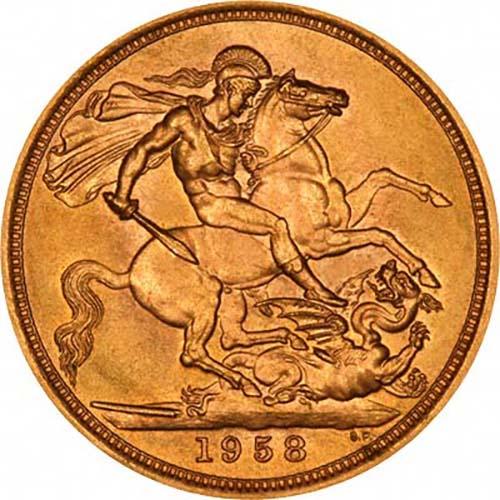
22-carat gold is tougher and more durable, making it ideal for coins that are handled regularly. Think of classics like Sovereigns and Krugerrands which have stood the test of time for centuries. On the other hand, 24 carat coins are purer, softer, shinier, and often seen as more prestigious. Coins like the Canadian Maple Leaf, made from 24-carat gold, only began production in 1979.
Here’s the technical bit:
- 22ct gold contains 91.67% pure gold, with the remaining .084 made up of base metals like copper, silver, zinc, or nickel.
- 24ct gold boasts 99.9% purity, with just a trace of other metals. So small, it’s often hard to identify.
So, which is better? That depends on what you value more: durability or purity. Same gold content, just different alloys.
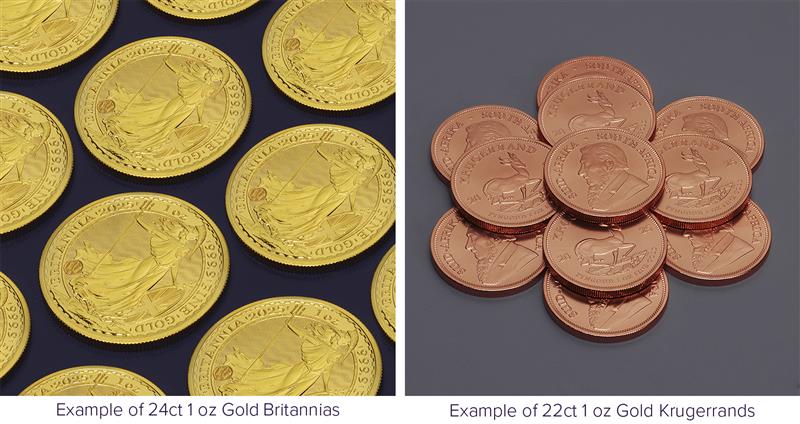
Here's the calculation:
Krugerrand contains 1 troy ounce of gold = 31.1035g. 31.1035g divided by the weight of coin 33.9305g = 0.9167 fineness x 24 = 22 carat
| Coin | Actual Gold Weight | Divided by Weight of Coin | Fineness | Carat |
| Krugerrand | 31.1035g | 33.9305 | 0.9167 | 22 carat |
| Britannia | 31.1035g | 31.21g | 0.9999 | 24 carat |
We should note that it is almost impossible economically or commercially to obtain absolutely pure gold. Before electrolytic refining, highly refined gold is usually .9995 pure (99.95%). If we convert this to carats, it would be 23.988 carats.
London Good Delivery Gold Bars are acceptable at .995 which is "only" 23.88 carats. To learn more you can read our Guide to London Good Delivery Gold Bars.
With electrolytic refining, it became commercially and economically possible to produce .9999 fine gold, which works out to 23.9976 carats. The Royal Canadian Mint also produces a .99999 fine gold coin, advertised as the world's purest gold coin. This works out at 23.99976 carats. It follows from this, that it is more accurate to refer to these coins by their millesimal fineness rather than as 24-carats.
22 Carat Gold Coins: A Timeless Tradition
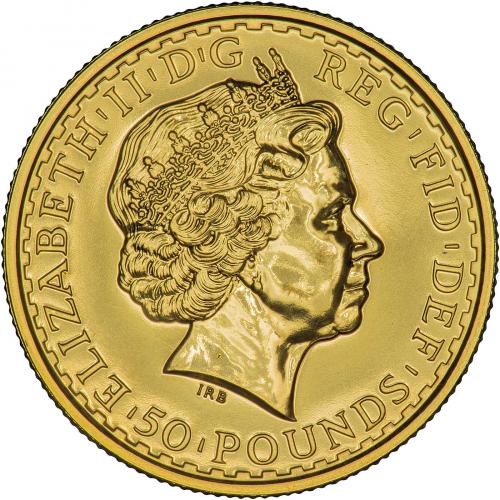
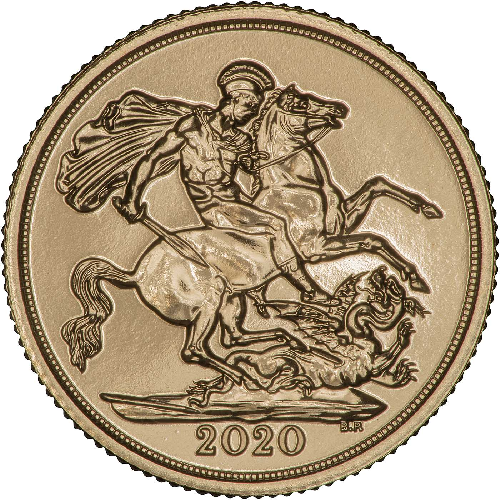
22 carat gold coins have been in circulation for thousands of years and were often made to .916 fineness or .900 fineness, depending on whether the coinage system was influenced by British or European standards. Coins made from 22-carat gold are stronger than those made from pure gold, as the addition of other metals creates a durable coin that is resistant to tarnishing and damage. Coins struck in 22 carat gold include the Krugerrand, modern American Eagles, Sovereigns, and Britannias (1997-2012).
Coins which are struck in 22 carat gold include Krugerrands, American Eagles, Sovereigns, Pre 2013 Britannias (1997-2012)


24 Carat Gold Coins: A Modern Masterpiece
In the 1980s, several mints began to issue 24-carat gold coins due to the perception that these coins were of higher quality than those made from 22-carat gold. The Royal Canadian Mint took this a step further by producing the 99999 Maples, which are considered to be the purest gold coins available. Despite this, the 99999 Maples still contain a minuscule amount of base metal that prevents it from being pure gold. Even though the 99999 Maple is classed as 24-carat gold, we have still seen coins with red spots** on them.
Coins that are struck in 24-carat gold include Maples, Pandas, Perth Mint’s Lunar and Kangaroo/Nugget coins, Philharmonics, Britannias (2013 to now), Queen's Beasts and British Lunar.


**Red spot is a natural process where the alloy oxidises and forms small reddish marks on the surface of the coin. We do not feel that this detracts from the value of the coin. Read more about red spot here.
How Much Gold In A One Ounce Coin?
Watch our video on how to measure the gold content of a 1-ounce gold coin.
Related Blog Articles












This guide and its content is copyright of Chard (1964) Ltd - © Chard (1964) Ltd 2026. All rights reserved. Any redistribution or reproduction of part or all of the contents in any form is prohibited.
We are not financial advisers and we would always recommend that you consult with one prior to making any investment decision.
You can read more about copyright or our advice disclaimer on these links.