
Are Gold Sovereigns a Good Investment?
Synopsis
The Sovereign is perhaps the most popular British bullion coin, but why is that?
In this blog we give an overview of the Sovereign's value performance over time and explain the benefits in having them in your portfolio.

Gold Sovereign Investment Performance at a Glance
The gold Sovereign has been a lynchpin of global bullion and gold investments for over 200 years. Since the modern Sovereign's introduction in 1817, the coin has been produced to exacting specifications and has built a worldwide reputation for consistency and liquidity.
For UK investors of the Sovereign, the coin offers exemption from both VAT, being minted from investment grade 22 carat gold, and Capital Gains Tax, with its status as pound sterling legal tender, as showcased by the 1 Pound denomination to the obverse of the coin.
But how has the value of the Sovereign fared?
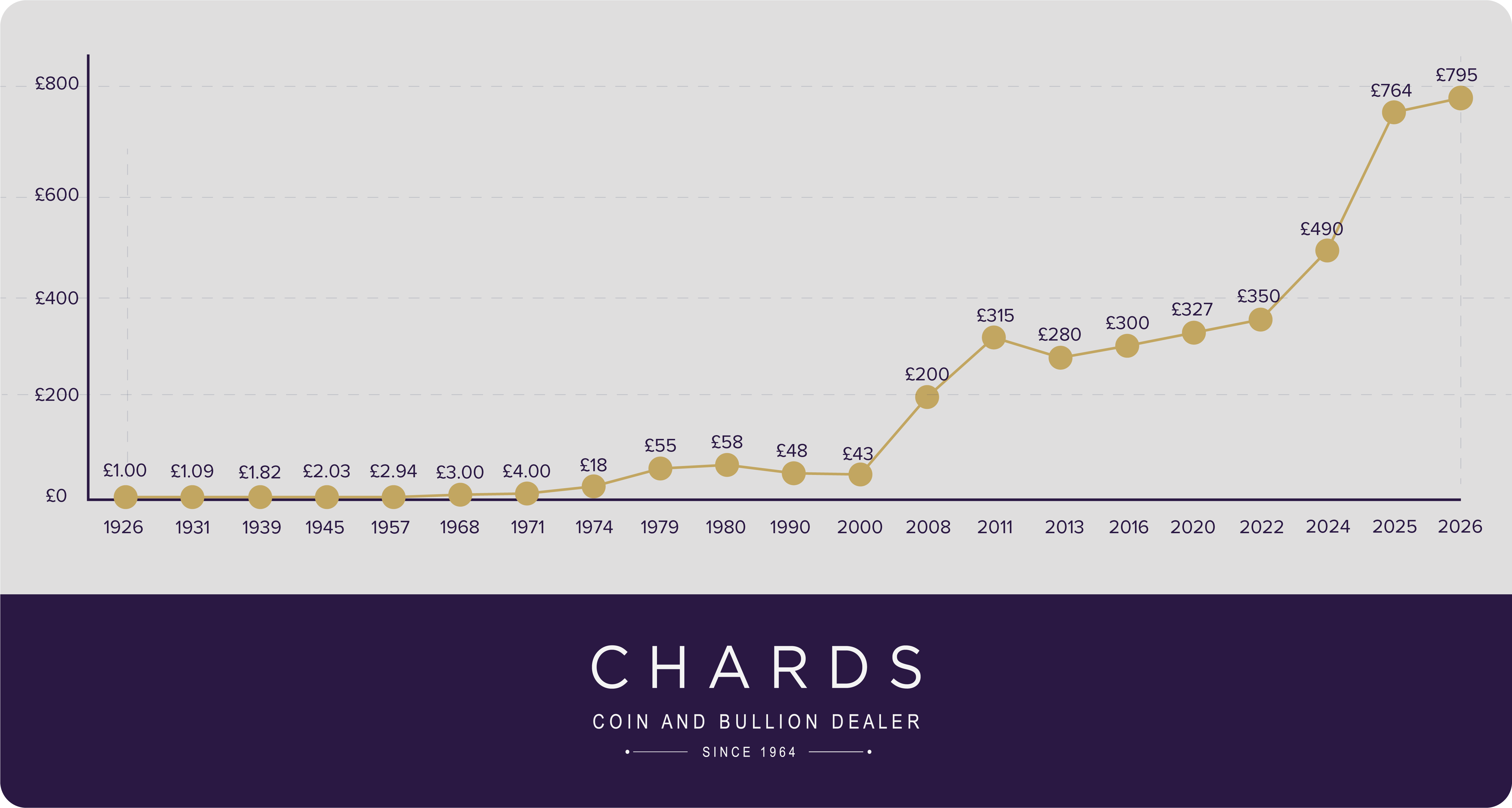
Year |
Value* |
What Happened? |
| 1926 | £1.00 | With Britain still adhering to the gold standard, gold's sterling price was effectively fixed, anchoring the Sovereign around £1. |
| 1931 | £1.09 | Britain abandoned the gold standard. Sterling depreciated, immediately increasing the sterling value of gold. |
| 1939 | £1.82 | WWII begins. Gold markets were disrupted and Britain moved towards wartime financial controls and banknotes. |
| 1945 | £2.03 | End of WWII. Gold remained controlled under the international monetary system being rebuilt around Bretton Woods. |
| 1949 | £2.92 | Major sterling devaluation, the pound fell from $4.03 to $2.80. Gold consequently became substantially more expensive in pounds. |
| 1954 | £2.94 | This was a relatively stable period under the Bretton Woods system, with official gold prices tightly controlled. |
| 1960 | £2.96 | Gold remained effectively anchored by the fixed-dollar/Bretton Woods system. |
| 1967 | £3.02 | Growing pressure on the Bretton Woods system and sterling; the pound was devalued in November 1967. |
| 1971 | £4.02 | The Nixon shock: the US suspended dollar convertibility into gold, effectively ending the old fixed-price monetary system. Gold began repricing freely. |
| 1974 | £18.77 | Inflation + oil crisis + monetary instability. Gold entered its great 1970s bull market. |
| 1979 | £55.36 | Explosive gold market driven by high inflation, second oil shock, Iranian Revolution and geopolitical anxiety. |
| 1980 | £58.18 | Peak of the great 1970s/early-1980s gold boom. Extremely high inflation and geopolitical risk pushed gold to historic highs. |
| 1990 | £47.79 | Gold fell from its 1980 peak as inflation subsided and interest rates rose. |
| 2000 | £43.05 | The end of gold's long 1980s–90s bear market. Strong equities, low inflation and the technology boom reduced demand for gold. |
| 2010 | £213.91 | Gold saw a sharp increase following the 2008 financial crisis, quantitative easing, ultra-low interest rates and concerns about the banking system. |
| 2015 | £168.64 | Gold was in a correction following its 2011 peak. Expectations of higher US rates and stronger financial markets reduced demand. |
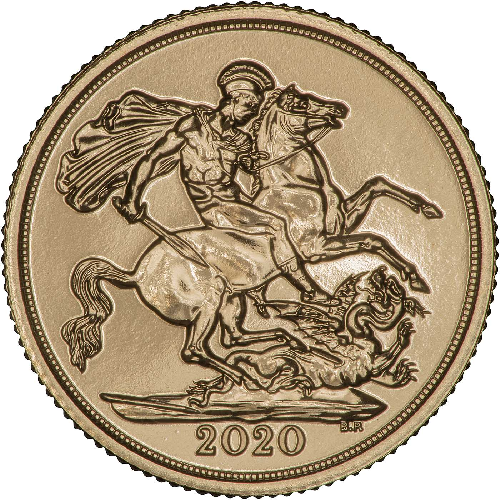
| 2020 | £326.98 | COVID-19. Massive monetary/fiscal stimulus, ultra-low rates and economic uncertainty drove gold sharply higher. |
| 2022 | £353.00 | Ukraine war, inflation and sterling weakness supported UK gold prices. |
| 2023 | £365.00 | Persistent inflation, banking-sector concerns and geopolitical uncertainty kept gold elevated. |
| 2024 | £491.00 | Gold entered another major acceleration, helped by central-bank buying, geopolitical risk and expectations of lower interest rates. |
| 2025 | £764.30 | Exceptional gold bull market. Gold made repeated records, driven by geopolitical uncertainty, central-bank demand and monetary concerns. |
| 2026 | £800.00** | Geopolitical uncertainty surrounding the US-Iran conflict, Fed decisions, rates and persistent central-bank demand left gold exposed to more volatility than historically seen. |
*approximate value when reviewing historic figures and performance.
**at time of writing, 24/08/2026.
How Much Would £1,000 Invested in Sovereigns Be Worth Today?
If you purchased bullion Sovereigns in the year 2000 at a price of £45 per coin, how would your investment have fared and what would it be worth today?
| Investment in 2000 | Sovereigns Purchased | Cost at £45 Per Coin | Approx. Value Today* |
| £1,000 | 22 | £990 | £17,387.04 |
| £5,000 | 111 | £4,995 | £87,725.52 |
| £10,000 | 222 | £9,990 | £175,451.04 |
*using gold spot price of £3,357.36 per troy ounce / £790.32 per Sovereign coin
Gold Sovereigns vs Savings Accounts
Many people rely on conventional high street bank savings accounts to house their money, with Cash ISAs being incredibly popular since their introduction in 1999 due to their tax-free status.
But how does a Cash ISA compare to gold? Using average data of interest rates per year, with interest compounded and no tax deducted, a Cash ISA looks something like the following for the same time-frame:
| Investment in 2000 | Approx. Cash ISA Value Today | Total Interest Earned |
| £1,000 | £2,000 | £1,000 |
| £5,000 | £10,000 | £5,000 |
| £7,000* | £14,000 | £7,000 |
*In the year 2000, Cash ISAs had a payment limit of £7,000
As we can see from the above tables, the gold Sovereign actually massively outperformed the Cash ISA for the same timeframe, with the earnings for the Sovereign investors still tax-free due to their exemption from both VAT and Capital Gains Tax.
What is the Best Gold Sovereign to Buy?
This is a question we are often asked however, it entirely depends on the buyer's circumstance!
If you are looking purely as an investment vehicle, then you'll want the cheapest bullion grade Sovereigns you can find, to maximise your investment to its fullest.
However, if you are a collector, numismatist or just interested in the historical aspect of the Sovereign, then dated, graded and commemorative coins will likely be your preference.
For more information on the differences between the finishes of Sovereign coins and the products sold at Chards, we recommend reading our blogs, What is Proof? An Overview of Coin Finishes and Coin Conditions - What is Mint, Pre-Owned, Grade C?
What Makes Gold Sovereigns Different From Other Gold Coins?
The Sovereign stands out against other gold coins with its historical stature, exacting specifications and global liquidity.
Not only is the Sovereign the oldest bullion coin to still be in production, with its origins dating back to the Tudor era under Henry VII, it is one of the most recognised coins in the world, holding the title of "Chief Coin of the World" due its role in the British Empire and spread of the Industrial Revolution.
With these historic ties, not only is there a market for investors, but collectors, too. As such, the Sovereign promises liquidity that many coins cannot rival, with a consistency in production since the introduction of the modern Sovereign in 1817.
Interested to know more? Read our article, The History of the Sovereign.

Things to Consider When Investing in Sovereigns
As with any investment into precious metals, we recommend taking your time and fully researching the market before making a purchase, making use of a financial adviser where possible.
It is always worth remembering that past performance is not indicative of future results, as seen in the chart at the top of this blog, world events make it so that nothing is ever a certainty.
When it comes to actually picking the Sovereign as your coin of choice, it really comes down to the gold quantity that you're wanting to invest in, as well as more personal factors such as whether you like the coin, the design and so on.
Sizes of Sovereigns
The Sovereign range allows for total control over your investments, with each coin in the line-up containing the exact gold content as the name suggests.
If you're looking for more information on the different sizes of Sovereign, we recommend reading through our Technical Specifications guide for each coin:


Frequently Asked Questions (FAQs)
Why should I buy gold Sovereigns?
Gold Sovereigns are one of the UK's most popular bullion coins, valued for their recognisable design, strong liquidity, and long history as an investment piece.
Are sovereigns exempt from Capital Gains Tax?
Yes. Gold Sovereigns are UK legal tender, making them exempt from Capital Gains Tax (CGT) for UK investors.
Do I pay VAT on gold Sovereigns?
No. Investment-grade gold Sovereigns are VAT-free in the UK, making them a tax-efficient way to own physical gold.
Should I buy new or pre-owned Sovereigns?
Pre-owned Sovereigns often offer lower premiums and are popular with investors seeking the best value, while new Sovereigns appeal to those who prefer freshly minted coins.
How much gold is in a full Sovereign?
A modern Sovereign contains 0.2354 troy ounces of gold and is struck in 22-carat gold (916.7 fineness).
Looking For More Reading?
You can read our full gold guide here and browse all of our individual gold advice articles here.
Related Blog Articles









This guide and its content is copyright of Chard (1964) Ltd - © Chard (1964) Ltd 2026. All rights reserved. Any redistribution or reproduction of part or all of the contents in any form is prohibited.
We are not financial advisers and we would always recommend that you consult with one prior to making any investment decision.
You can read more about copyright or our advice disclaimer on these links.